
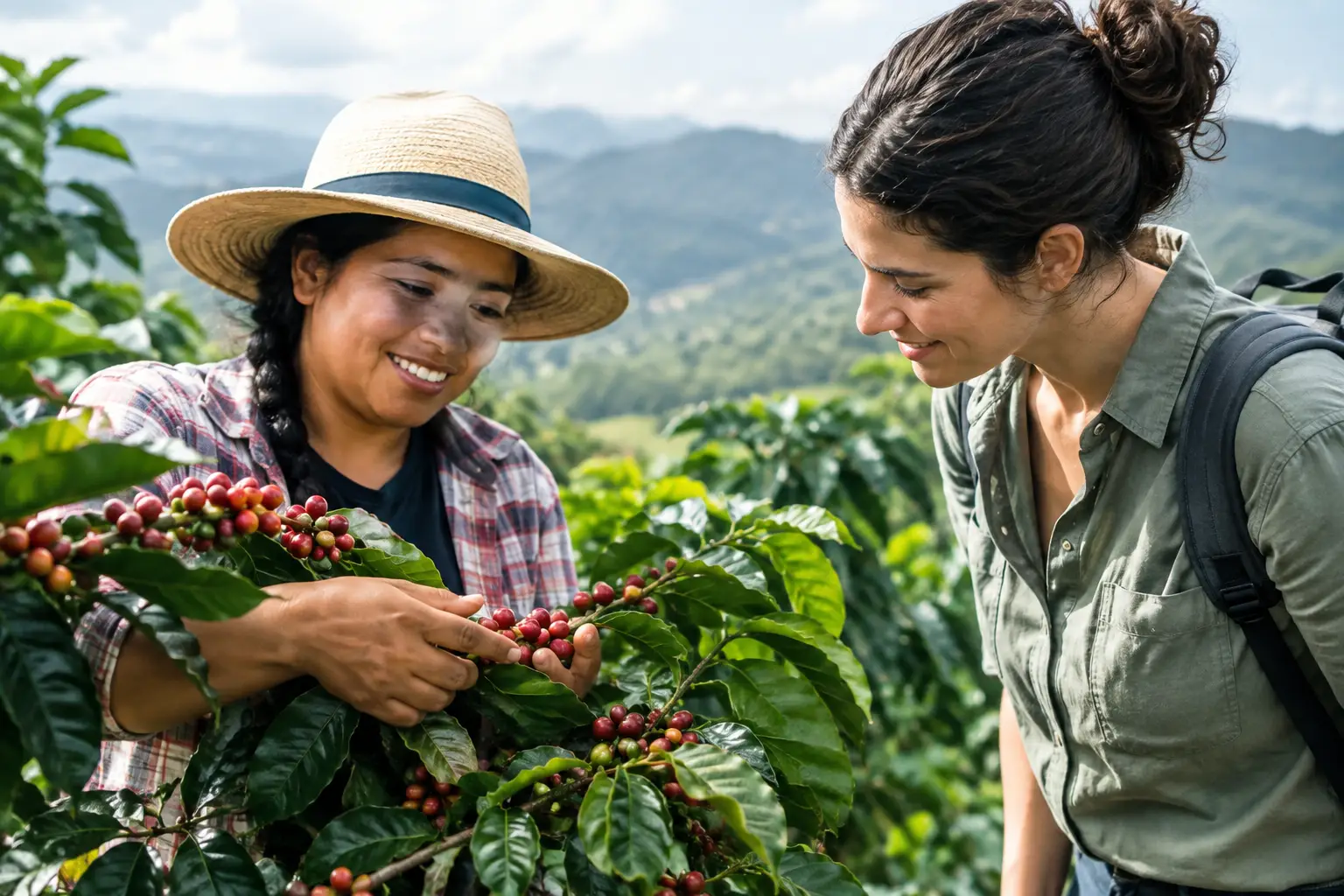
A good flat white on a busy Fore Street morning should do more than wake you up. It should taste sweet, balanced and properly cared for from the farm to the cup. That is the point of this guide to ethical coffee sourcing: helping you understand what sits behind a coffee that feels good to buy, not just good to drink.
Coffee is grown a long way from Exeter, often by smallholder farmers working with unpredictable weather, rising costs and a market that has not always rewarded their labour fairly. There is no magic label that solves every problem. But there are better questions to ask, better buying relationships to support and better coffee to look for when you are choosing your daily brew.
What ethical coffee sourcing really means
Ethical sourcing is about how coffee is bought, traded, processed and brought to your neighbourhood. At its heart, it means growers and workers should be paid fairly enough to run viable farms, invest in their communities and keep producing great coffee year after year.
That includes more than the price paid for green coffee. It can mean long-term relationships between roasters and producers, clear information about where beans come from, safe working conditions, responsible environmental practices and a realistic approach to farming challenges. If a coffee’s story stops at a vague claim such as “responsibly sourced”, it is fair to want more detail.
For a café, ethical sourcing also means treating the coffee with respect once it arrives. Excellent beans can be spoiled by stale storage, rushed extraction or milk steamed without care. A fairer supply chain deserves a properly made cup.
Start with traceability, not glossy promises
Traceability is one of the clearest signs that a roaster knows its coffee beyond a bag design. It means they can say where the coffee was grown, often naming the country, region, cooperative, estate or farm. The more specific the information, the easier it is to understand the journey behind your espresso.
A single-origin coffee might be traceable to one farm or a small area, while an espresso blend combines coffees chosen for a consistent flavour. Neither is automatically more ethical. A blend can be sourced with real care, and a single origin can still come with limited information. What matters is whether the roaster can explain its buying approach and whether its claims stand up to a straightforward question.
Look for useful details: harvest period, producer group, processing method, the importer or direct-trade partner, and what the roaster pays attention to when selecting beans. You do not need a lecture with your cappuccino. But a café should be proud to tell you why a coffee is on the grinder.
Fair pay is the part that matters most
Coffee prices rise and fall on the commodity market, but the cost of growing coffee does not politely follow suit. Farmers still need to pay workers, maintain land, manage pests, process cherries and support their households. A price that looks cheap at the till may be built on pressure somewhere else in the chain.
Ethical roasters often pay above the commodity price and may pay quality premiums for carefully produced lots. Some work through importers with established producer relationships; others buy directly where that model genuinely works. Direct trade can be a positive sign, but it is not a regulated certification by itself. The phrase only means something when it comes with transparency about price, partnership and purchasing commitments.
Certifications such as Fairtrade, Rainforest Alliance and organic can also be useful. They set standards and bring structure to complicated supply chains, particularly at scale. Yet they are not a complete scorecard. Certification costs can be difficult for some small producers, and a non-certified coffee may still be bought through a thoughtful, higher-paying relationship. The sensible approach is to see certifications as one piece of evidence, rather than the whole story.
Local roasting matters, with one honest caveat
Coffee cannot be grown on Devon soil, but it can be roasted locally and chosen thoughtfully. Working with local or trusted UK roasters keeps the relationship between café, roaster and customer closer to home. It can mean fresher coffee, quicker conversations about a seasonal change and better accountability when something is not tasting right.
Local roasting also supports skilled jobs in the UK and reduces unnecessary layers between the people brewing the coffee and the people buying it. That said, “local” is not a shortcut for ethical. A nearby roaster still needs to be open about how it sources green coffee and who benefits from the price it pays.
The sweet spot is coffee that has been responsibly bought at origin, roasted with skill nearby and brewed by someone who cares. That is the sort of detail you can taste in a well-pulled espresso: depth without harshness, sweetness without syrup and a finish that makes you take another sip.
Environmental care is part of the same conversation
A coffee farm is not separate from its landscape. Changing rainfall, hotter temperatures and plant disease are already affecting yields and livelihoods in many coffee-growing regions. Ethical sourcing should account for environmental resilience as well as social fairness.
That might include shade-grown coffee, soil health, careful water use during processing, reduced chemical inputs or programmes that help farmers replant ageing trees. There are trade-offs here. Washed coffees can use significant water, while natural processing may use less water but needs dry, stable conditions and careful handling. There is no single perfect method for every farm and climate.
Transport matters too, although coffee’s biggest impact is often linked to farming, processing and how a drink is served. Choosing a reusable cup when you are taking an Americano through Fore Street is a practical win. So is ordering only what you will enjoy, rather than treating good coffee as disposable fuel between meetings.
How to ask better questions at your local café
You do not have to become a coffee buyer to make a more informed choice. A friendly, curious question goes a long way: where are these beans from? Is this a seasonal coffee? Who roasts it? What does the roaster share about the producer?
The answer does not need to be packed with jargon. In fact, clear, plain-speaking answers are usually the most reassuring. A good barista might tell you that the espresso is a locally roasted blend built for chocolatey comfort in milk drinks, or that the filter is a fruitier single origin with a named region and seasonal harvest. That is useful information, whether you are a coffee nerd or just after something decent before work.
It is also worth remembering that ethical buying costs more. Farmers deserve sustainable prices, roasters need to roast and deliver carefully, and independent cafés have real overheads. Paying a fair price for a coffee does not mean paying silly money or accepting poor service. It means recognising that a brilliant cup, made with care, cannot be built on cutting every corner.
A guide to ethical coffee sourcing for everyday drinkers
Your everyday choices have more power when they become habits. Support independent cafés that know their roasters. Choose places where staff can talk about the beans without reading a script. Try the seasonal coffee now and then, especially if it gives producers a route to market for distinctive lots rather than only high-volume commodity coffee.
At Creeks Cuppa, that care belongs in the ordinary moments: the takeaway latte before the school run, the flat white between lectures, the iced mocha shared with a mate, or a quiet table and a pastry when Fore Street needs to slow down for a minute. No corporate nonsense, just properly made coffee from beans selected with flavour, provenance and people in mind.
Ethical sourcing will never be a finished box to tick. Harvests change, prices move and every supply chain has room to improve. Keep asking where your coffee comes from, notice who is willing to answer, and let your regular order support the kind of coffee culture you want to see around Exeter.